

Blog
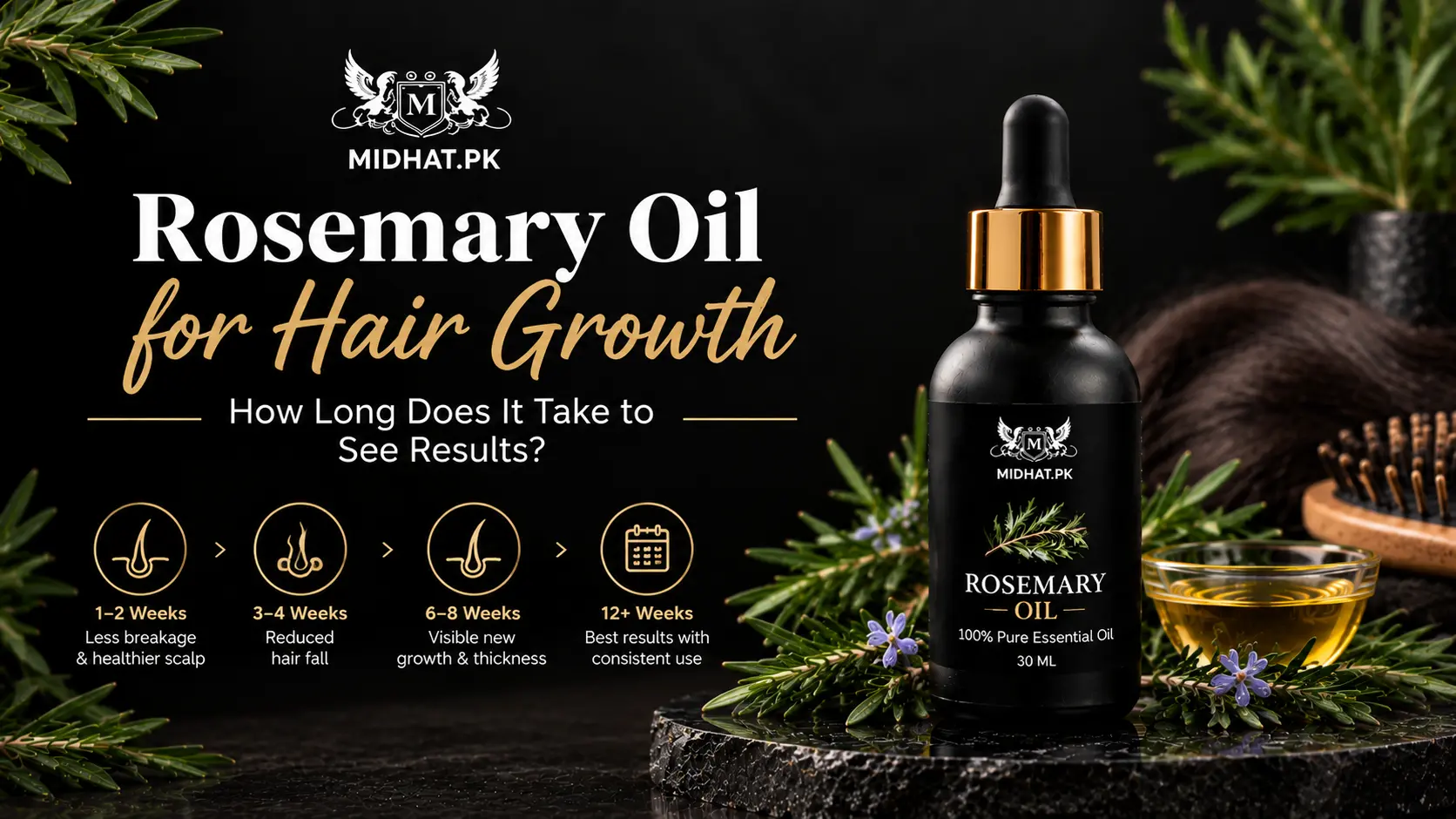
Rosemary Oil for Hair Growth: How Long Does It Take to See Results?
Rosemary oil has become a popular addition to hair-care routines, especially for people looking for natural ways to support their scalp and hair. But one of the most common questions is how long does rosemary oil take to grow hair?
The answer is not a few days or even a couple of weeks. Hair naturally grows slowly, and any hair-care routine needs consistent use before you can reasonably judge the results. Research on rosemary oil has shown some promising findings, but the evidence is still developing and individual results can vary.
If you want to add rosemary oil to your routine, you can explore Midhat’s Rosemary Oil for Hair growth for product details and usage information.
In this guide, we’ll explain how long rosemary oil may take to show results, what you can realistically expect each month, how often to use it and what factors can affect your results.
How Long Does Rosemary Oil Take to Grow Hair?
Rosemary oil should not be treated as an overnight hair-growth solution.
Hair follicles work through different growth phases, so visible changes naturally take time. Applying rosemary oil several times does not suddenly speed up this biological process.
One clinical trial compared rosemary oil with 2% minoxidil in people with androgenetic alopecia over six months. The study found an increase in hair count after six months, while there was no significant change at the three-month assessment.
This does not mean everyone using rosemary oil will experience the same results. Your genetics, age, hair-loss pattern, scalp condition, lifestyle and consistency can all influence your experience.
For more background, you can read Midhat’s Rosemary Oil for Hair: Benefits, Growth, and How to Use It Naturally.
Rosemary Oil Hair Growth Timeline
There is no guaranteed timeline for everyone, but looking at your routine in stages can help you maintain realistic expectations.
First 1–4 Weeks: Getting Your Routine Started
During the first month, your main goal should be building a consistent routine rather than looking for dramatic hair growth.
You may notice that your scalp feels more moisturized or that your hair feels different after regular oiling. These changes can be part of your hair-care routine, but they should not automatically be considered evidence of new hair growth.
This is also the stage when you should pay close attention to how your scalp responds.
If you are using rosemary essential oil, make sure it is appropriately diluted before applying it to your scalp.
Weeks 5–8: Monitoring Your Hair and Scalp
After the first month, continue using rosemary oil consistently if your scalp is tolerating it well.
You may notice changes in scalp comfort, hair texture or manageability. However, visible changes in hair density can still be difficult to identify at this stage.
Avoid comparing your hair every day because normal shedding and changes in styling can make results difficult to judge.
If you are interested in comparing different oils, Midhat’s Best Hair Oil in Pakistan guide can help you understand different options commonly used in hair-care routines.
Months 3–6: Give the Routine More Time
This is the stage where patience becomes particularly important.
Research involving rosemary oil has examined longer periods of use rather than expecting immediate results. The well-known clinical trial comparing rosemary oil and 2% minoxidil assessed participants over six months.
That means judging your rosemary oil routine after only two or three weeks may be premature.
If you are using rosemary oil consistently and your scalp remains comfortable, give your routine enough time before deciding whether it suits you.
Why Does Rosemary Oil Take Time to Work?
Hair growth is a gradual process.
Rosemary oil does not instantly create new follicles or make existing hair grow overnight. Its potential role in hair care is being studied because rosemary contains compounds with antioxidant and other biological properties.
Some research has investigated rosemary oil in relation to scalp health and hair growth, but more evidence is needed to understand exactly how it may work and which people are most likely to benefit.
This is why it is better to think of rosemary oil as part of a broader hair-care routine rather than a guaranteed treatment for hair loss.
Does Rosemary Oil Really Help With Hair Growth?
Some research suggests that rosemary oil may have potential for supporting hair growth.
A randomized comparative trial involving rosemary oil and 2% minoxidil found that both groups had an increase in hair count after six months. However, this single study is not enough to establish rosemary oil as a guaranteed treatment for every type of hair loss.
Results can also vary depending on why someone is losing hair.
For example, hair shedding related to genetics may require a different approach from hair loss caused by nutritional deficiencies, hormonal changes, stress or scalp conditions.
If your hair loss is sudden, severe or persistent, it is better to consult a dermatologist rather than relying only on rosemary oil.
How Often Should You Use Rosemary Oil for Hair Growth?
Consistency is more important than applying a large amount of oil.
A practical starting point for many people is two to three times per week, while paying attention to how the scalp responds.
Using rosemary oil more frequently does not automatically mean faster hair growth. Excessive application may leave the scalp greasy or increase the chance of irritation.
If you are new to rosemary oil, start gradually and maintain a simple routine.
For detailed application instructions, read Midhat’s How to Apply Rosemary Oil for Hair: Step-by-Step Guide.
How to Use Rosemary Oil for Better Results
1. Apply It to the Scalp
If your goal is to support scalp and hair care, focus your application on the scalp rather than simply coating the lengths of your hair.
Part your hair into sections and apply a small amount of properly diluted rosemary oil to the scalp.
2. Dilute Rosemary Essential Oil
Rosemary essential oil is concentrated and should not be carelessly applied directly to the scalp.
A suitable carrier oil can be used to dilute it before application.
Jojoba oil is one option that can work well as a carrier oil. Midhat’s Jojoba Oil can be incorporated into an oil-based hair-care routine.
You can also read Jojoba Oil Benefits for Skin & Hair for more information about using jojoba oil.
3. Massage Your Scalp Gently
After applying the diluted mixture, gently massage your scalp with your fingertips.
Use small circular movements and avoid scratching with your fingernails.
The goal is to distribute the oil across the scalp without creating unnecessary friction or irritation.
4. Keep Your Routine Consistent
One of the biggest mistakes people make is changing their routine every few days.
If you are using rosemary oil safely and your scalp tolerates it, give the routine enough time before judging the results.
5. Track Your Progress
Taking photographs can help you monitor gradual changes.
Take pictures every four weeks using similar lighting, camera positioning and hairstyle.
Comparing photographs taken several months apart is usually more useful than checking your hair in the mirror every day.
Rosemary Oil Before and After: What Should You Expect?
Before-and-after photos can be useful, but they should be viewed carefully.
Hair can look thicker or thinner depending on lighting, styling, hair length and even how recently it was washed.
For a more useful comparison, photograph the same area of your scalp under similar conditions.
Also remember that individual results are not guaranteed. A photograph showing improvement in one person does not mean the same result will happen for everyone.
Can Rosemary Oil Help With Hair Fall?
Rosemary oil may be included in a hair-care routine for people concerned about hair shedding, but it should not be presented as a guaranteed solution for hair loss.
Hair fall can have many causes, including:
- Genetics
- Hormonal changes
- Stress
- Nutritional deficiencies
- Certain medications
- Scalp conditions
- Illness
- Physical or emotional stress
If your hair loss is sudden or significant, identifying the underlying cause is more important than simply adding another oil to your routine.
Rosemary Oil and Jojoba Oil: Can You Mix Them?
Yes, jojoba oil can be used as a carrier oil for rosemary essential oil.
The combination can be convenient for people who want a simple scalp-oiling routine while keeping the rosemary oil diluted.
Jojoba oil and rosemary oil have different roles. Jojoba oil works as a carrier and conditioning oil, while rosemary essential oil is highly concentrated.
You can also read Midhat’s Jojoba Oil for Skin guide to learn more about jojoba oil’s broader uses.
Rosemary Oil for Different Hair Types
| Hair Type | Suggested Approach |
|---|---|
| Dry hair | Use a small amount with a suitable moisturizing carrier oil. |
| Oily hair | Use less oil and wash thoroughly after treatment. |
| Fine hair | Avoid heavy application that can make the hair look flat or greasy. |
| Thick hair | Divide the hair into sections to reach the scalp properly. |
| Sensitive scalp | Use a suitable dilution and patch-test before wider application. |
| Normal hair | Start with a consistent 2–3 times per week routine. |
Your hair type can influence how much oil feels comfortable, but the concentration of rosemary essential oil should still be considered.
Can You Leave Rosemary Oil Overnight?
Some people prefer applying diluted rosemary oil at night and washing their hair the following morning.
However, overnight application is not required for everyone.
If you have an oily or sensitive scalp, leaving oil on for a shorter period may be more comfortable.
If you notice itching, burning, redness or irritation, wash the oil out and stop using it.
The important point is not how long you can tolerate a large amount of oil, but whether the routine is comfortable and appropriate for your scalp.
Precautions When Using Rosemary Oil
Before adding rosemary oil to your hair-care routine, keep these precautions in mind:
- Do not apply undiluted rosemary essential oil directly to your scalp.
- Perform a patch test before wider application.
- Avoid contact with the eyes.
- Do not swallow essential oil.
- Stop using it if you experience burning, itching or redness.
- Keep essential oils away from children.
- If you are pregnant or breastfeeding, speak with a healthcare professional before using essential oils.
- If you have an existing scalp condition, ask a healthcare professional before starting a new routine.
- Consult a dermatologist if you experience persistent or significant hair loss.
Natural ingredients can still cause irritation, especially when highly concentrated.
When Should You Expect Rosemary Oil Results?
The most important thing to remember is that rosemary oil results take time.
You may notice changes in hair texture or scalp comfort sooner, but these are different from measurable changes in hair density.
Rather than expecting results within a few weeks, focus on maintaining a consistent routine for several months.
The available clinical research involving rosemary oil has examined longer periods, including a six-month treatment period.
If you are documenting your progress, take photographs at regular intervals and compare them over time.
When Should You Stop Using Rosemary Oil?
You should stop using rosemary oil if your scalp develops persistent:
- Burning
- Redness
- Itching
- Swelling
- Significant irritation
- Pain
Wash the product out and avoid continuing the application if your skin reacts badly.
You should also seek professional advice if your hair loss is sudden, severe, patchy or continues to worsen.
Rosemary oil can be part of a cosmetic hair-care routine, but it cannot identify or treat every underlying cause of hair loss.
Where to Buy Rosemary Oil in Pakistan
If you are searching for rosemary oil in Pakistan, check the product information before purchasing.
Look for clear ingredient information, suitable packaging, directions for use and information about the product size.
Midhat offers Rosemary Oil for people who want to add rosemary oil to their hair and scalp-care routine.
You can also explore Midhat’s Essential Oil collection if you want to compare rosemary oil with other essential oils.
For more options and information about hair oils, read Midhat’s Finding the Best Hair Oil in Pakistan guide.
Frequently Asked Questions
1. How long does rosemary oil take to grow hair?
Rosemary oil does not produce instant hair growth. Available research has examined longer periods of use, and one clinical trial found a significant increase in hair count after six months. Individual results can vary.
2. Can I see rosemary oil results in one month?
One month is generally too soon to judge rosemary oil’s potential effect on hair growth. You may notice changes in scalp comfort or hair texture, but visible changes in density can take much longer.
3. How often should I use rosemary oil for hair growth?
A practical starting point is two to three times per week. Adjust the routine depending on how your scalp responds and avoid assuming that more frequent application will automatically produce faster results.
4. Can I use rosemary oil every day?
Daily use is not necessary for everyone. A consistent routine using an appropriate amount is generally more practical than applying large amounts every day. If your scalp becomes irritated, stop using it.
5. Can I mix rosemary oil with jojoba oil?
Yes. Jojoba oil can be used as a carrier oil to dilute rosemary essential oil before topical application.
6. Does rosemary oil guarantee hair growth?
No. Some research suggests potential benefits, but rosemary oil is not a guaranteed treatment for hair loss. Results depend on the individual and the underlying cause of hair loss.
Final Thoughts
If you’re wondering how long rosemary oil takes to grow hair, the most realistic answer is that you need patience and consistency.
Do not expect noticeable hair growth after a few applications or a couple of weeks. Hair naturally grows slowly, and research involving rosemary oil has looked at longer periods of use.
A sensible routine includes properly diluting rosemary oil, applying a small amount to the scalp, gently massaging it and using it consistently while monitoring your scalp’s response.
If you want to try rosemary oil as part of your routine, explore Midhat’s Rosemary Oil for Hair and follow the product’s usage instructions.
If you are experiencing significant or unexplained hair loss, however, speak with a dermatologist to identify the underlying cause rather than relying only on a hair oil.