

Blog
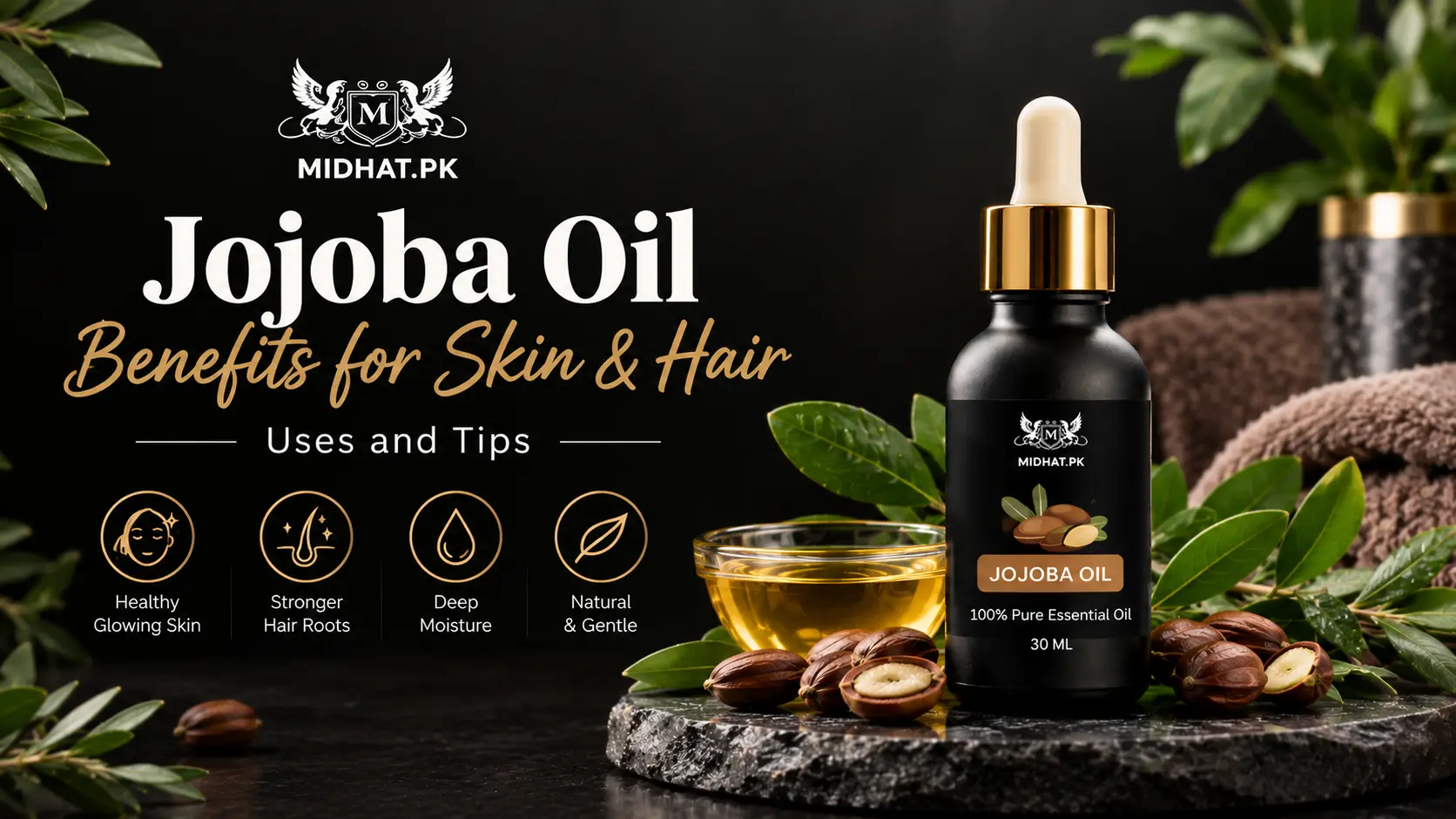
Jojoba Oil Benefits for Skin & Hair: Uses and Tips
Jojoba oil benefits make this versatile ingredient popular in both skincare and hair-care routines. If your face feels dry, your hair ends look rough, or you want a simple multipurpose beauty product, jojoba oil may be worth considering. The key is knowing what it can realistically do and how much to apply.
Jojoba oil is extracted from the seeds of the Simmondsia chinensis plant. Although commonly called an oil, it consists mainly of liquid wax esters. This unusual composition helps explain why it is widely used in moisturizers, facial oils and hair conditioners. For a closer look at the ingredient and available product sizes, explore Jojoba Oil by Midhat.pk.
Below, we explain its everyday cosmetic uses, practical application methods and precautions for different skin and hair types.
What Is Jojoba Oil?
Jojoba oil comes from the seeds of a drought-tolerant shrub native to North America. Its liquid wax structure differs from the triglycerides that make up most familiar plant oils. Researchers have studied its chemistry, topical applications and possible biological properties. For a scientific overview, see this peer-reviewed review of jojoba oil’s chemistry and uses.
In Pakistan, jojoba oil is often sold for both facial skincare and hair conditioning. Before buying, check the product label, ingredients and storage instructions. Midhat’s guide to buying jojoba oil in Pakistan offers additional local product information.
7 Jojoba Oil Benefits for Skin and Hair
1. Helps Soften Dry-Feeling Skin
One of the most practical jojoba oil benefits is its emollient effect. A small amount can help rough or dry skin feel smoother and more comfortable. Apply it after a moisturizer rather than treating facial oil as a complete replacement for hydration.
For a more detailed facial routine, read Midhat’s Jojoba Oil for Skin: Benefits, Uses & How to Apply. The American Academy of Dermatology’s dry-skin moisturizer advice also explains how to choose an appropriate moisturizing product.
2. Supports a Simple Moisture-Retention Routine
Facial oils can help reduce the feeling of dryness when used alongside a suitable moisturizer. For best results, cleanse gently, moisturize while your skin is slightly damp and then apply one or two drops of jojoba oil if needed. This can be useful during dry winter weather or after frequent washing.
If you are new to facial oils, start with a small amount of Midhat’s jojoba oil and observe how your skin responds before increasing the frequency.
3. Can Improve the Look of Dull, Dry Skin
When skin feels dry, its surface may look rough or less radiant. Jojoba oil can give dry areas a smoother, conditioned appearance. However, it is not a proven treatment for dark spots, melasma or permanent skin lightening. Daily sunscreen remains important if uneven pigmentation is a concern.
4. Helps Condition Dry Hair Ends
Jojoba oil can be used as a finishing oil on the mid-lengths and ends of dry-looking hair. Rub one or two drops between your palms and gently smooth them over the ends. Start with less if your hair is fine or naturally oily.
For a complete application routine, see Midhat’s Jojoba Oil for Hair: Benefits, Uses & How to Apply. The article covers pre-shampoo treatments, hair ends and ways to adjust the amount for different hair types.
5. Fits Into Pre-Shampoo Hair Care
If your hair feels rough after styling or washing, try a short pre-shampoo treatment. Apply a modest amount to the lengths and ends, leave it for around 20–30 minutes, then wash with a gentle shampoo. You can follow with conditioner as usual.
Jojoba oil can improve the feel of dry hair, but it cannot repair every type of structural damage or reliably regrow lost hair. Scientific reviews discuss its cosmetic applications without establishing ordinary jojoba oil as a proven hair-loss treatment. See the research review on jojoba oil for background.
6. Offers a Multipurpose Beauty Option
A small bottle of jojoba oil can be used on dry facial areas, elbows, knees and hair ends, provided your skin tolerates it. This can simplify a routine that otherwise relies on several separate finishing oils.
If you want to compare other products, browse Midhat’s jojoba oil collection. Remember that concentrated essential oils are different from jojoba oil and may need dilution before skin use.
7. Works in Different Cosmetic Formulations
Jojoba oil is included in moisturizers, cleansing products, conditioners and facial oils because of its texture and conditioning properties. A dermatology review discusses its role in skincare formulations and the scientific interest in its potential anti-inflammatory effects. These findings should not be taken as proof that a home application treats acne, eczema or infections. Read the dermatology review of jojoba for further context.
How to Use Jojoba Oil for Skin
- Wash your face with a gentle cleanser.
- Apply your usual moisturizer while your skin is slightly damp.
- Place one or two drops of jojoba oil on clean fingertips.
- Gently smooth it over dry areas, avoiding your eyes.
- In the morning, finish with broad-spectrum SPF 30 or higher sunscreen.
If you have oily or acne-prone skin, use a very small amount and watch for breakouts. The American Academy of Dermatology’s acne moisturizer guidance explains why non-comedogenic products may be preferable for acne-prone skin.
How to Use Jojoba Oil for Hair
For dry ends, use a drop or two after washing. For a pre-shampoo treatment, distribute a little oil through the lengths, wait 20–30 minutes and wash it out. Avoid saturating your scalp, particularly if it becomes oily quickly.
You can explore jojoba oil for hair and skin at Midhat.pk if you prefer one product for both routines.
Which Skin and Hair Types Can Use Jojoba Oil?
- Dry skin: Try a few drops after moisturizer to reduce the feeling of dryness.
- Oily skin: Start with one drop; discontinue if it increases greasiness or breakouts.
- Sensitive skin: Patch-test first and stop if irritation develops.
- Dry hair: Apply a small amount to the mid-lengths and ends.
- Fine hair: Use sparingly to avoid a heavy or greasy appearance.
- Curly or coarse hair: Adjust the amount according to how your hair responds.
Does Jojoba Oil Help Hair Growth or Treat Acne?
These are common questions, but the evidence needs careful interpretation. Reviews describe interesting laboratory findings and traditional uses; they do not prove that ordinary jojoba oil will regrow hair or cure acne. For persistent acne, scalp irritation or sudden hair loss, seek advice from a qualified healthcare professional.
For everyday cosmetic use, focus on the more established benefits: conditioning dry-feeling skin, smoothing hair ends and making your routine easier to manage.
How Often Should You Use Jojoba Oil?
Start with two or three evenings per week for facial use or once weekly for a pre-shampoo hair treatment. You may adjust the frequency depending on your skin or hair type. Using more oil does not necessarily improve results, and too much can leave your face or hair greasy.
Precautions Before Using Jojoba Oil
- Patch-test before applying it over a large area.
- Avoid contact with your eyes.
- Stop using it if you develop itching, redness or new breakouts.
- Do not use it instead of sunscreen or prescribed treatment.
- Follow the product’s storage instructions and do not ingest cosmetic jojoba oil.
Where to Buy Jojoba Oil in Pakistan
When shopping online, check the ingredients, bottle size, seller information and product instructions. If you want a local option, visit Midhat’s Jojoba Oil product page to review the current details and availability. You can also consult the Best Jojoba Oil in Pakistan guide before choosing.
Frequently Asked Questions
1. What are the main jojoba oil benefits?
The main everyday cosmetic benefits include softening dry-feeling skin, improving the look of rough hair ends and providing a versatile ingredient for simple skin and hair routines.
2. Can I use jojoba oil on my face every day?
Some people can, but start with a small amount a few times a week. Adjust according to your skin type and stop if irritation or breakouts occur.
3. Is jojoba oil good for dry hair?
It can help dry hair feel smoother and more manageable when applied sparingly to the lengths and ends.
4. Does jojoba oil grow hair faster?
There is insufficient strong clinical evidence that applying ordinary jojoba oil makes hair grow faster or reverses hair loss.
5. Can jojoba oil remove dark spots?
It can improve the appearance of dryness but is not an established treatment for pigmentation or dark spots.
6. Can oily skin use jojoba oil?
Some people with oily skin tolerate it, but start with one drop and monitor for excess shine or breakouts.
Final Thoughts
Jojoba oil benefits are most useful when viewed as part of a realistic cosmetic routine. It can help dry skin feel softer, improve the appearance of rough hair ends and serve as a multipurpose finishing oil. It should not replace medical treatment or daily sun protection.
To explore a local option, visit Jojoba Oil by Midhat.pk and follow the product instructions when adding it to your routine.